


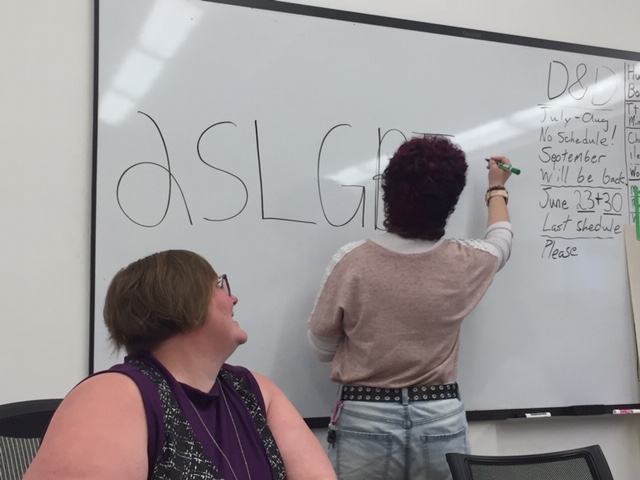
Members of the Humboldt and Area Pride Network came together to host a panel at the Reed-Thompson Public Library welcoming any inquiries regarding the 2SLGBTQIA+ community. The event was called Queeries, a clever play-on-words that invited people to ask questions about queer identities, experiences and allyship. This is the second article on Discover Humboldt covering this event.
Related Stories:
- Humboldt Library hosts Queeries panel on 2SLGBTQIA+ topics
- June events at the Humboldt library
- Pride colours brighten downtown Humboldt as community gathers for annual sidewalk painting
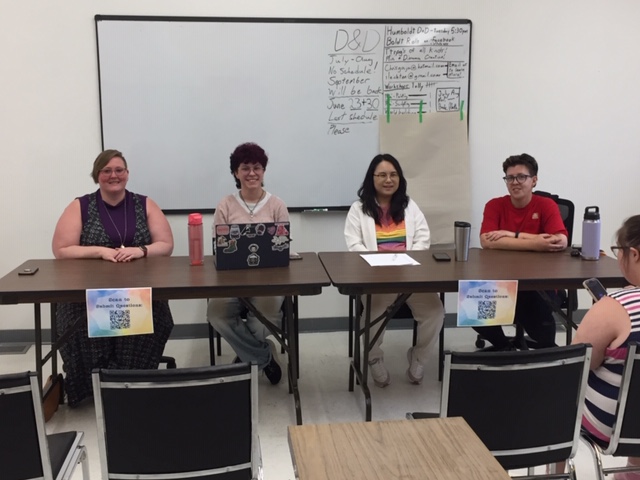
The discussion panel consisted of Amanda Baldwin, Hyerim Park, Taylor Moisan, and Carissa Lukan.
A question was raised regarding the school system, and whether queer people feel accepted or not.
“I can give my impression of high school from three years ago,” Lukan said. “I was born and raised here in Humboldt, so I've been graduated from high school for three years. But There were some teachers who did their best. You can definitely find the good teachers at HCI.”
According to Lukan, some classmates learned discriminatory attitudes outside of school and brought them into the classroom. Some teachers turned a blind eye to the bullying and didn’t intervene.
“But the teachers that were good, they would pull you aside afterwards and be like – are you okay? Do I need to do anything? Is there anything I can do to support you? So, at least in Humboldt, from when I was going, they're on the track to supporting their students and making sure that everybody's doing well, but obviously there's always room for growth,” Lukan said.
Trauma at schools
This was three years ago, but for Baldwin, horrific stories of bullying are everyday occurrences. Now a trauma therapist with a private practice in town, youth come in with problems at school. Baldwin used to work in the school division and left it because of the way queer folks were being treated.
“One of the most useful things I do in my office with queer youth is I make sure they understand that the problem isn't in them, right? So, we specifically talk about how the problem is in society, that homophobia exists in society, that transphobia exists in society. It's outside of you,” Baldwin said. “One of the very first queer kids that came into a counseling office to see me, said, I know why I'm here. And I was like, oh, why are you here? She said, my mom called you because she wanted you to fix the gay. And I was like, oh, honey, she sent you to the wrong place then because there's nothing wrong with the gay, right? The gay is welcome here, the gay is normal, the gay is valid, it's beautiful, it's lovely, and we did a lot of work.”
Korea to Humboldt
A minister at Westminster United Church, Hyerim Park is from South Korea. A lesbian, Park made the decision to leave her country with her wife and move to Canada to have the freedom to live as they want to live. Yet, even in Humboldt, she is cautious of when they’re holding hands or displaying signs that they’re in a relationship together. She informed the audience that in Korea, much of the population is Christian, and during Pride month, they would show up in the streets, praying to fix the gay. As a former school teacher in Korea, she always had to lie about herself as a lesbian or she risked being fired.
“It's very hard, but we are, anyway, we are happy here, to be here anyway, legally protected. And we are surrounded by really good people,” Park said. "But I don't know if it's really safe, you know, on the street or in the school where we are ever in Humboldt.”
Coming out every day
Lukan added to the school conversation by sharing about her personal experiences attending events through the library at Humboldt’s two Catholic schools. Not knowing whether she’ll be accepted as she is, she tries to dress as feminine as possible so the teachers won’t get upset or harshly shush any questions about her appearance if she were to dress in her regular attire.
“I have to put that thought in every time. And lots of queer people do every day, unfortunately,” Lukan said. “That's the beauty of Pride to recognize how far we've come, where we are legally protected in Canada and there are good teachers at schools. And we are able to, I can come into work and I can dress however I want. I can tell people my pronouns – doesn't matter – and I can still hold my job. So we've made that progress, but there's still progress to be made as well.”
A lot of queer people don’t just have to come out once about how they identify themselves. It’s every day that someone may ask questions or make assumptions that everyone is heterosexual and cisgender, and that the queer person doesn’t know whether it’s safe to answer honestly.
“Like, you go to find a place to live in and suddenly you have to tell them you have a partner. You can say partner, but are they going to ask, oh, do you have a wife and kids? No, I have a partner. Leave it at that. And yeah, you're constantly having to do that stuff. I just had a co-worker of mine ask about a month ago, he's like, hey, do you live alone or do you have a hubby? And I was like, I don't have a partner, no,” Moisan said, sharing their experience. “It's a little frustrating to constantly have to deal with stuff like that. And I know a lot of people don't think about that kind of thing. But I'm like, just don't do that, please. Like, it's very exhausting to think about whether you want to come out to that person or not.”
Supporting Pride
The panel offered suggestions on how to show others that you are a safe and supportive person. You can promote the Pride colours, whether that’s putting a sticker on your car or wearing a pin. You can make your own decorations or art as well that indicate that you are an ally to the queer community. You can also educate yourself with books from the local library or panels like Queeries. Donations or volunteering with the Humboldt and Area Pride Network is also supportive, but make sure that the event connects back to this non-profit as there have been some scams using the rainbow colours where the money doesn’t actually go to the 2SLGBTQIA+ community.
Baldwin talks about Pride. “When you think about Pride, Pride's always been rebellion, right? Yes, it's a celebration and it's great that we can, you know, paint the town with rainbows and do beading. Like, it's great that we can do all of those things, but at its very core, if we're not active in like getting rid of homophobia purposefully and changing the systems that continue to reproduce it over and over and over again and harming people, then we are, we have forgotten the roots of Pride.”
Social media is another place where you can support Pride Month by sharing posts or events in connection to it. There is also a lot of unsupportive social media content, and the panel gave some suggestions for how to approach people who are being disrespectful, whether online or in person.
“If you see they've posted a not appropriate or a rude comment about the community, you can just say, this is hate speech. That's it. You don't have to say much more than that. This is hate speech. It's very powerful in terms of educating what is and isn't hate speech,” Baldwin said. “Because free speech, if it has a cost to the queer community, is not free.”
Baldwin and Lukan also suggested other phrases that can be used in the face of hurtful comments. Tell me why that’s funny. This phrasing puts in on the commentor to either admit that they were homophobic or racist, or question why they said what they said. Another suggested response to a hurtful or prejudiced comment was: ‘That’s a weird thing to say.’
Lukan shares why they’re proud to be queer. “I actually don't know the history of why we call it Pride. That's one I don't know. But I like Pride because I am proud of myself. I'm proud of how far I came with accepting who I am and being able to say it in a room full of people I don't know very well. because for a long time I couldn't. It was whispered or it was typed on my phone and then closed that up immediately. So I am proud. It is pride for me because I'm proud of what I've done for myself.”
You can also be proud if you don’t identify as part of the 2SLGBTQIA+ yourself, but you are an ally of the community.
“You are making a safe space for all of these other people that maybe aren't proud of who they are,” Baldwin said, then added. “I think folks are proud of simply persevering in the face of phobias and bigotry.”











 Thu, Jul 2, 9:45 AM


 Full-time, Hourly, Labour
 Featured